Global Affairs
In an interdependent world, global affairs can no longer be understood—or governed—through power alone.
Global Affairs: Seeing the World More Clearly
Much of how we think about global affairs begins with a simple assumption: that the world is made up of separate actors—states, leaders, civilizations—each pursuing its own interests in a competitive and often hostile environment. From this premise follows a familiar logic. Power must be accumulated. Security must be defended. Cooperation is fragile and temporary.
This view, most commonly associated with political realism, captures something important. Conflict is real. Power matters. Good intentions alone do not prevent harm. But realism is also incomplete. By treating rivalry and self-interest as permanent features of political life rather than as historically and socially produced patterns, it mistakes a partial description of world politics for reality itself.
My work starts from a different place: interdependence.
Beyond the Illusion of Separation
Interdependence is often discussed today as a policy condition—globalization, trade, climate change, pandemics. But at a deeper level, interdependence describes how the world actually works. No state, economy, or society exists in isolation. Political outcomes emerge from dense networks of economic, ecological, cultural, and institutional relationships.
When this reality is ignored, policy becomes distorted. Efforts to secure advantage often generate new vulnerabilities. Actions taken in the name of stability produce instability elsewhere. What looks like strategic success in the short term frequently undermines long-term security.
Seen in this light, many global crises are not failures of power, but failures of perception.
The Half Truth of Power Politics
Political realism warns—correctly—against naïve moralism. But it goes too far when it assumes fear, domination, and zero-sum competition are unavoidable. These behaviors are not hard-wired facts of international life; they are responses shaped by how actors understand themselves and others.
When states see themselves as fundamentally separate, insecurity multiplies. When they assume well-being can be achieved at others’ expense, conflict becomes self-reinforcing. The tragedy realism describes is real—but it is not inevitable.
Ethics Are Already at Work
Ethics in global affairs are often dismissed as aspirational or impractical. In reality, ethical assumptions are already embedded in political systems. Every order answers, implicitly or explicitly, basic questions: Who counts? What harms matter? How far do responsibilities extend—across borders, generations, or ecosystems?
Ignoring these questions does not make policy more realistic; it simply leaves its moral foundations unexamined.
Learning from Comparative Experience
Bhutan offers a rare contemporary example of a society that has sought to organize democracy, development, and governance around principles other than pure growth or individual self-interest. Grounded in Buddhist ideas of equality, non-harm, and responsibility to the natural world, Bhutan’s experience shows that alternative moral frameworks can coexist with modern institutions—even under global pressure.
Bhutan is not a model to be copied. It is a case that expands our sense of what is politically possible.
Toward a Clearer Realism
In an age of climate disruption, global pandemics, technological risk, and deep inequality, the belief that security can be achieved in isolation is increasingly untenable. No state can wall itself off from systemic harm.
Recognizing interdependence does not eliminate conflict. But it helps us see where our inherited assumptions mislead us—and where more durable forms of cooperation and restraint might emerge.
The central claim of my work is simple: global stability depends not only on power and institutions, but on seeing the world as it is—interconnected, fragile, and shared.
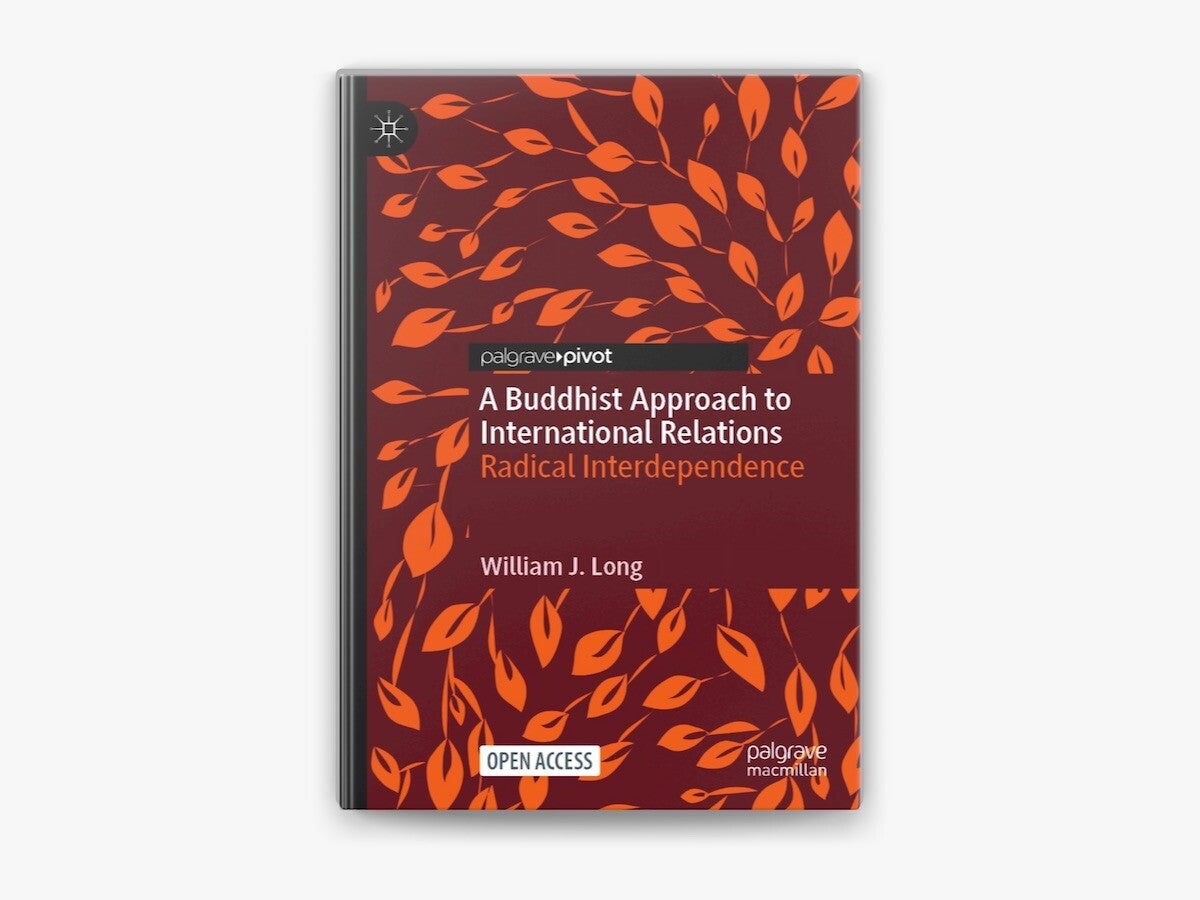
Interdependence and Global Stability
Modern international politics is shaped by dense networks of economic exchange, environmental risk, and security interdependence. Treating states as autonomous actors pursuing narrow self-interest obscures the real sources of both conflict and cooperation. I analyze how recognizing interdependence changes our understanding of sovereignty, security, and responsibility.
Radical Interdependence emphasizes that all things, beings, and phenomena are deeply connected, lacking independent existence (emptiness or sunyata), and rely on conditions for their arising, offering an alternative to Western models by fostering compassion, shared responsibility, and ethical statecraft beyond self-interest.
Reviews
“Long’s work is a seminal contribution considering Buddhism as the source of alternative discourse in International Relations. … Long’s book is a great contribution to the theoretical literature in international relations.” (Punsara Amarasinghe, Religious Studies Review, Vol. 49 (1), March, 2023)

Why Bhutan?
What a small Himalayan democracy reveals about what modern democracies are missing
Bhutan is easy to dismiss. For some, it is too small, too remote, too culturally distinctive to matter for the serious business of modern democratic theory. For others, it is romanticized as a Himalayan Shangri-La—interesting perhaps, but analytically unserious. Both reactions miss the point.
Bhutan matters not because it offers a model to be copied, but because it offers a contrast that clarifies. In an era when many democracies are struggling with polarization, inequality, institutional paralysis, and ecological strain, Bhutan provides a rare opportunity to examine democracy built on a fundamentally different moral and philosophical foundation than liberal individualism. That difference helps illuminate what modern democracies increasingly lack—and why procedural fixes alone are proving insufficient.
Not a model, but a mirror
Bhutan does not claim to export its system, and it should not. It is a small country of fewer than one million people, with a distinct history and a Mahāyāna Buddhist culture that has shaped its institutions for over a millennium. But precisely because Bhutan developed modern democratic and market institutions without passing through the Western Enlightenment, it offers an unusually clear comparative case.
Most contemporary democracies—whether in Europe, the Americas, or Asia—share the same underlying “operating system”: liberal assumptions about the individual self, human motivation, economic progress, and the role of the state. Bhutan does not. Its constitution, public philosophy, and development strategy are grounded explicitly in Buddhist principles, not liberal ones. That makes Bhutan analytically valuable even where its size and culture make it politically non-transferable.
Comparison, since Aristotle, has been one of the most powerful tools of political understanding. Bhutan allows us to compare not just different institutions, but different starting assumptions about democracy itself.
A different balance of rights and responsibilities
One of the clearest distinctions between Bhutanese democracy and liberal democracy lies in how each balances individual rights and social responsibilities.
Liberal democracies are built primarily around rights: freedom of expression, property, association, and choice. Duties to others are typically thin, legalistic, or implicit. Bhutan’s democracy, by contrast, articulates both rights and responsibilities explicitly. Its constitution guarantees civil and political liberties while also affirming citizens’ duties to one another, to society, and to the natural environment.
This difference flows from a deeper philosophical premise. In Buddhism, the individual self is not understood as an autonomous, self-subsisting unit. Human beings are fundamentally interdependent—socially, economically, and ecologically. From that perspective, freedom without responsibility is incoherent. Rights are essential, but they are insufficient on their own to sustain a healthy democratic order.
The result is a democratic vision that places greater emphasis on civic virtue, restraint, deliberation, and care for the common good—without rejecting elections, constitutionalism, or markets.
Happiness as a political question
Bhutan is best known internationally for its commitment to Gross National Happiness (GNH), often misunderstood as a feel-good slogan or a quirky alternative metric. In fact, GNH reflects a serious claim: that the purpose of government is not merely to maximize economic output, but to create conditions that support human flourishing in a fuller sense.
In the Bhutanese Buddhist understanding, genuine and lasting happiness is not identical with consumption or material accumulation. It is primarily a state of mind—cultivated through ethical conduct, emotional balance, compassion, and insight into our interdependence with others. Material security matters deeply, but as a means, not an end.
Accordingly, Bhutan’s development strategy prioritizes poverty eradication, universal access to health care and education, meaningful employment, cultural continuity, and environmental protection alongside economic growth. Bhutan remains carbon-negative, with constitutional protections for forest cover, even as it modernizes and integrates into global markets.
This does not mean Bhutan has solved the problem of happiness. In fact, recent data suggest that spiritual and psychological well-being may be under pressure as modernization accelerates—a challenge Bhutan is openly debating. But the willingness to treat happiness, broadly understood, as a legitimate object of public policy already marks a sharp departure from dominant economic orthodoxy.
Democracy as a moral practice, not just a procedure
Perhaps the most important lesson Bhutan offers concerns how democracy works, not just how it is designed.
Modern democracies have invested heavily in procedures—elections, checks and balances, transparency rules—while paying far less attention to the moral and psychological capacities of citizens and leaders. Yet democracy cannot be sustained by institutions alone. It also requires citizens capable of deliberation, restraint, empathy, and concern for shared outcomes.
Bhutan’s democratic framework places unusual emphasis on these qualities. Political participation is encouraged not merely through voting, but through dialogue and deliberation. The influence of money in politics is tightly constrained. Leaders are expected—normatively and institutionally—to demonstrate integrity, modesty, and a willingness to compromise.
This emphasis does not arise from naïveté about power or conflict. It reflects a sober recognition that unchecked self-interest, when institutionalized, corrodes democratic legitimacy over time. In that sense, Bhutan’s approach echoes a neglected strand of Western thought—from Aristotle to Adam Smith’s Theory of Moral Sentiments—that understood markets and democracy as resting on moral foundations they cannot generate on their own.
Beyond Shangri-La
Bhutan is not utopia. It faces real challenges: youth unemployment, regional inequality, the pressures of globalization, and the risk that material success may erode the very values that distinguish it. Its experiment is unfinished and uncertain.
But dismissing Bhutan as irrelevant because it is different misses the deeper point. Precisely because it is different, Bhutan helps reveal what many democracies have quietly lost sight of: that democracy is not only a system of rules, but a way of cultivating citizens capable of living together in conditions of deep interdependence.
Bhutan does not offer answers ready for export. It offers something more valuable—a reminder that democracy’s long-term viability depends not just on institutions and incentives, but on how societies understand the self, the common good, and our responsibilities to one another and the natural world.
That insight, though ancient in origin, may be newly relevant.
For a deep dive into Bhutan and its relevance see my book:
Tantric State: A Buddhist Approach to Democracy and Development in Bhutan (New York: Oxford University Press, 2019).